Learn · An essayService and money
What Is Freely Given, and What Must Be Sustained
On receiving money for your service.
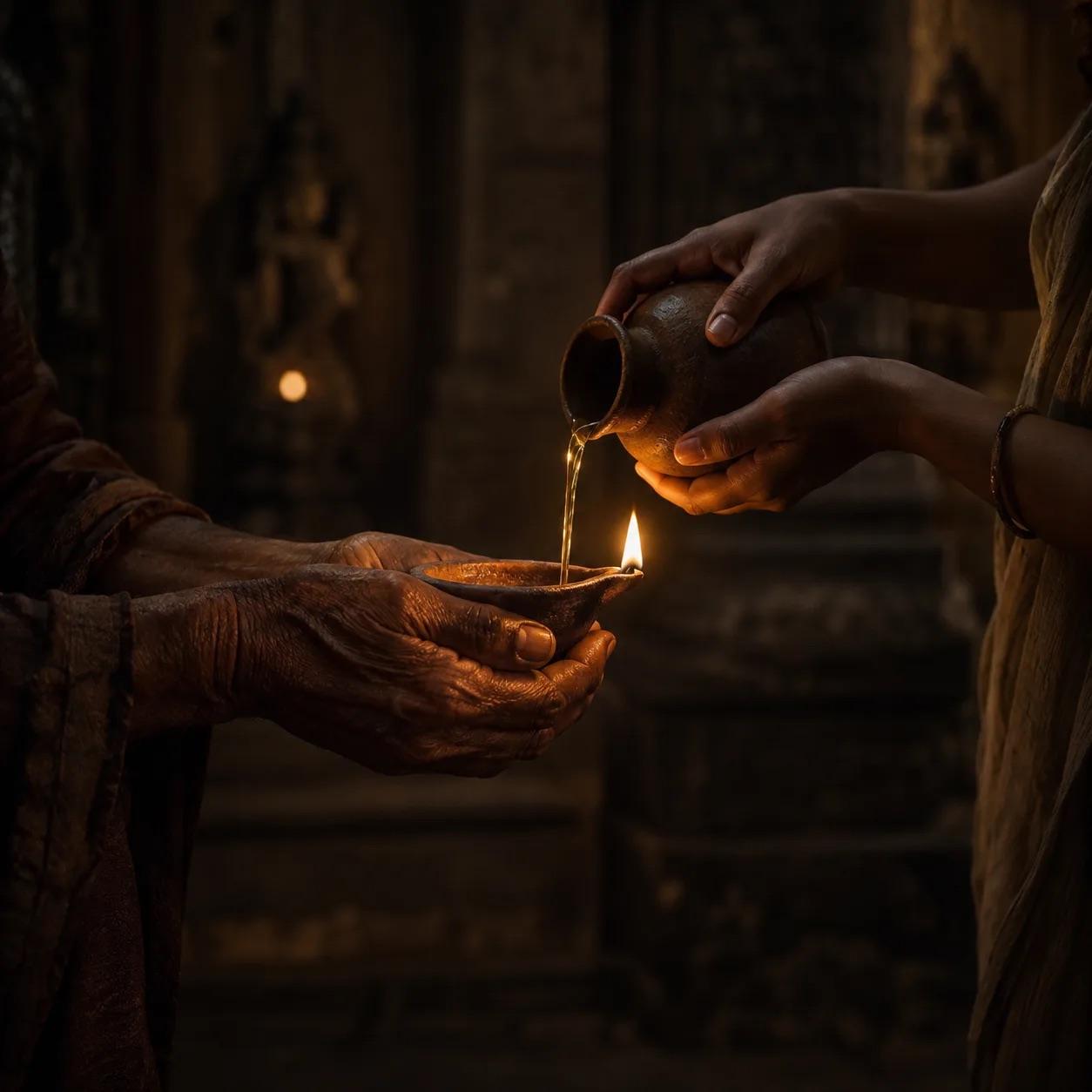
Here's a question that comes up every now and then, and I've noticed it's not only asked by people who want to teach — it touches anyone whose work serves something higher than themselves, whether that is awakening, beauty, truth, art. For years I carried a quiet conflict about it myself, and I rarely spoke about it. However, over time, through experience, it all came clear to me and has been clear for a while. I never felt the need to communicate it, but I've received the question more often recently, especially from people feeling called to be of service themselves. Heather, for example, posted a dream relating to selling her beautiful paintings which took months to make. So here I am, putting into words what my heart feels about all of this, spoken from someone who has lived both sides of the conflict.
It seems timely that I write this now after having several services to offer the world through the app and the website, but I'm not writing this to try and sell you anything, I just want to share how I got to this point, and hopefully inspire you if you are thinking of being of service in your own way.
Freely You Have Received
Let us begin with the belief that some spiritual circles hold: that sacred teaching should never cost anything — I understand where it comes from, because I once held it myself. Jesus told his disciples, "Freely you have received, freely give," and this is true, since no one can sell awakening, and no price in the world can buy the moment a person sees themselves clearly for the first time. But, that is not what we are paying for.
You see, in the very same breath, Jesus also told them that the worker deserves his keep. He was sending them out to teach, and he told them to accept the food and the shelter of those they served. Paul later said it even more plainly, that those who teach the way should be able to live from it. The truth then, is free, and the person of service is never expected to starve.
What costs something is everything that surrounds the teaching — the room, the equipment, the travel, the recordings, the time, the food on the teacher's table, basic needs, and the family waiting at home. And above all, the work and labor itself, which nobody ever sees. None of this is free, however much we pretend it is.
A friend of mine, an instructor, once told me about the free classes he used to give. There came a day when he had to move the classes into a rented meeting room, and he could not cover the cost himself — he had to consider charging the students. It troubled him deeply for a while. Eventually he prayed to his Divine Mother and he asked her whether it was right to charge his students. In a dream, she answered him plainly: "These teachings are not free!"…
His Divine Mother was speaking of something far deeper than money. Something this precious, this valuable, is never cheap to carry, and it costs something to walk the path. Almost everyone here knows that it has cost you something to walk this path — whether it is your ego, old friends, ambitions, moments of tears and pain, etc. To find the inner path is akin to finding an oasis in a desert. If you were in a desert, would you rather search for months without food, or get a helping hand from someone who knows the way? And if you received help, would you reciprocate, or brush him off?
The Labor No One Sees
Most people only ever see the hour of a meeting, class or course, and so they never see what stands behind it. They do not see the years of practice that came first, the meditations that went nowhere, the long stretches of starting again from the beginning, because before anyone can teach something real, they have to live it, and living it takes years. Every clear sentence a teacher speaks has been paid for in private, with effort no one witnessed.
There are the weeks spent working through one teaching until it finally becomes simple enough to hand to someone else, the writing and the rewriting, the slides built and the lessons recorded and edited, and then whole sections thrown away because they were not true or clear enough. A course that takes eight weeks to attend can easily take eight months to make. And then there is the work that carries on long after the class has ended, the messages answered late at night, the student in crisis who needs a careful reply, the one who writes at three in the morning because they cannot sleep, the questions that deserve real thought rather than a quick response.
However, the deepest cost is an inner one. To teach from direct experience, rather than from a book or something you learned on the internet, a person has to be present, and they have to give something of themselves. This is nothing like reciting information. It draws on something far deeper, and that something has to be renewed constantly through the teacher's own practice, or it runs dry. Gurdjieff taught that conscious labor, the kind of effort a person makes with full awareness and sincerity, is one of the foundations of the inner path. Real service is that kind of labor. It is not simply a job a teacher performs; it is part of their own inner work, and it asks for their whole presence every time.
Real service, then, is never improvised whimsically or capriciously. It is built slowly, with effort, the way a craftsman builds something meant to last, and we would never ask a carpenter to give away months of his work, nor would we ask a doctor to heal us for nothing. So why should work that helps a person understand their own consciousness be worth any less?
When someone pours that much of their life into the work, it is not greed to ask for a fair return. It is simply honest. And the right amount is the one that honors the labor without exploiting the student.
The Hidden Cost of "Free"
When a teacher, or anyone else, refuses all payment, someone still pays. Usually it is the teacher, or their family, or the quality of the work itself. The classes become irregular, the material stays half-finished, and the teacher either burns out or quietly takes a second job and gives the work whatever is left over at the end of the day. This app alone cost me close to $1000 a month to keep running, and without support it would either disappear or slowly lose its quality. In the end, the students lose most of all, because all they'd receive are the remains — including the remains of the teacher's energy, rather than the best of it.
The "free" model has another hidden cost, and it is one I have watched closely. When nothing is charged openly, the money tends to come in through the back door instead, in donation boxes passed around with quiet pressure, in guilt, in unspoken expectations and favors owed. A clear, fair price is so much cleaner. Everyone knows where they stand, nothing is hidden, and no one has to dance around awkward guilt-ridden requests. I saw this recently with an organization I deeply respect. Their work is excellent, and it has helped thousands of people, myself among them. For years they relied on donations, and over time the appeals became more frequent and more pressing, until eventually they announced they would be scaling back their work because not enough had come in. I understand the exhaustion behind that decision, I truly do. But the message carried a trace of bitterness, as though the people they had served had let them down, and that is the quiet trap of the donation model: when support does not arrive, the resentment has somewhere to go. A fair price, stated openly from the beginning, would have spared everyone that.
And I noticed something else. Whenever they did charge for something, they felt the need to justify it, to explain and almost to apologize, and this is not needed at all. An honest price, set with a clear conscience, can simply stand on its own. The moment we over-explain it, we are telling people that some part of us still believes we are doing something wrong. This is also why I do not write any of this as a defense. I write it for those who serve and who carry the same quiet conflict I once did.
What the Student Gives
Now there is another side to all of this, and it concerns the student. People tend to value what they have invested in, and Gurdjieff understood this well, holding that what people receive for nothing they treat as nothing. Something given away freely is so often received carelessly, left half-read and half-practiced. A fair exchange, you see, is a gesture of commitment. It says, quietly, I am taking this seriously, and it opens the door rather than closing it.
I have seen this in my own work too. Over the years I have watched people enter for free only to disrupt, or to hurt others with ideas that came from a mind and a heart that never took the work seriously in the first place. And so payment can even become part of the student's own work, because for many of us money is where the ego holds on tightest, and to give something of real value in exchange for the chance to change is already a small act of sacrifice. Sacrifice has always been part of the path.
Do not mix ego with money. Those who hold on to it, are attached to it. Those who love to spend it, are attached to it. People who greedily exploit others by overcharging, are attached to it. People who are uncomfortable with accepting money, are attached to it.
A Generous Heart
There is also something deeper here, something about the heart itself, and I want to be careful how I say it, and to be clear I am not speaking about those who genuinely cannot afford it. Real poverty, and stinginess, are two very different things, and some of the most generous people I have ever known had almost nothing — common in the Philippines. I am speaking of the person who could give but resents it, who argues over a few pennies for something that took months to make. In my experience, a person who is cheap with money is usually cheap in spirit as well, and the same pattern shows up everywhere in their life, in how they listen and in how they treat the people around them.
Generosity, you see, is a quality of the heart long before it is a matter of money. It is an openness, a willingness to give something of yourself. A kind person knows how to listen, because listening is itself a form of giving; you set aside your own noise to make room for someone else. A stingy heart cannot do this. It holds on to everything, including its own opinions, and so it hears very little. And this work is mostly listening, to a teacher, to one another, and above all to the subtle voice of one's own Being.
A heart that cannot give cannot really listen, and a heart that cannot listen is simply not ready yet for this kind of work.
The Bible puts it very simply — one person gives freely and only grows richer, while another holds back what they owe and only grows poorer. However, this was never only a teaching about money. It is a law of the inner life. What we clutch closes, and what we give opens.
Nothing Served on a Plate
And so it is no accident that the person who expects the teaching for free so often expects the transformation for free as well. Some people want the fruits of the path without ever walking it. Some people want to teach others without putting in hard work. Others want the insight without the practice, the experiences without the discipline, the followers without the service, the trust of others without the years it takes to earn it. Some people expect everything to be served to them on a plate, and when it is not, or when they watch someone else's work bearing fruit, what rises in them is resentment, and sometimes outright jealousy.
But nobody can see the planting from the harvest. When people look at a teacher with students, or a book on a shelf, or a channel that reaches thousands, they are looking at the fruit. They do not see the seasons of planting that came before it. The blood, sweat and struggle. The videos that reached a handful of people. The classes taught to three people in a small room. For me, it was endless hours of work after coming home from a 12-hour shift. Some people think "wow I could easily do that!" without a clue about the grueling work and struggle it often takes to get to that stage.
I'm not saying you need to suffer in the same way to be successful, but it does take a certain level of commitment and hard work in order to "earn your keep". Good ideas and good intentions are not enough on their own. Almost everyone has great ideas. Only a few have the work ethic to turn it into something real in the world.
Jealousy, looked at honestly, is usually a way of avoiding our own work, because it is so much easier to resent someone else's harvest than to plant our own seeds. And if we feel it, as all of us do at times, it is a signal rather than an injustice, pointing straight back at ourselves: here is something you long for, and here is the work you have not yet done.
And here is what is so rarely understood. What is handed to us on a plate cannot nourish us. Knowledge received without effort stays on the surface as shallow, passing information, words on a surface, and it never becomes understanding, because understanding is formed by the effort itself; the struggle to grasp something is the very way it enters us and becomes ours. Gurdjieff spoke of the difference between knowledge and being, and I have seen it many times, a person who knows a great deal and remains completely unchanged. Only the work changes us. This is why the path cannot be bought, and why it cannot be given away for free either.
To anyone who feels they are already wise and wonders why no one listens, I would offer this gently. True wisdom is never claimed. It is recognized, slowly, because it has been lived, and authority on this path is never taken. It grows quietly through years of sincere effort, until others can feel it directly without so many words.
On the Identification of Being a Teacher
Now let us be honest about the teacher's side as well. Some of us feel uncomfortable charging because, deep down, we believe money is unspiritual, but that belief is itself another kind of attachment, only turned inside out — a person who is truly free in relation to money can receive it without greed and spend it without guilt. Fear of money and craving for money are two sides of the same coin.
And I have noticed that the discomfort with charging often walks hand in hand with another discomfort — the discomfort of being called a teacher at all. Some of you have said to me, quite sincerely, "but I'm not a teacher," and then, in the very next breath, gone on to share something wise and beautiful with the person in front of you. You see, whenever someone is truly listening, and something in them opens and begins to learn, a teacher is present, whether anyone calls it that or not. In that moment the power to influence another person has been placed in your hands, whether you like it or not, and this is a divine responsibility. It cannot be removed simply by saying you are not a teacher.
However, there is a difference between a role and an identity. Teaching is a purpose that arises in-the-moment, on the moving surface of life whenever there is a chance to be of service, and then it passes. Who we truly are has nothing to do with it. And so to insist "I am a teacher" and to insist "I am not a teacher" are the same mistake. They are both ego. Both are identifications, and both are a way of escaping the simple responsibility of the moment, because the humble refusal is very often the ego hiding in a quieter costume. The real work is to recognize, moment by moment, when that role has become active and to meet it with care.
And in truth, every one of us is already a teacher, because we are always teaching ourselves. Each time we speak something true aloud, the Word works on us as much as on the one who hears it. There is a transmission in the voice, and it passes through the speaker first. We are all teachers and we are all students.
There is one more thing worth saying here. Being awake and being able to teach are two different things, and we should never confuse them. Awakening is a matter of being, while teaching is a craft, with skills and a work ethic that must be developed like any other. I have met people far from enlightened who were wonderful teachers, and others with real depth who could barely pass on a thing. Even a realized master has to approach service with the same humility and hard work as anyone else, preparing carefully and learning, again and again, how to give. Which brings us back, once more, to the labor.
An Honest Exchange
So the real question was never whether to charge. It is how to charge with integrity, and for me that comes down to a few simple things. We charge for the time and the labor, and never for the truth itself. We price fairly, enough to honor the work and never more than it is worth. We stay transparent, with no hidden fees, no pressure, no guilt, and no apologies either. We keep some of the teaching freely available, so that anyone can begin, and we keep a door open for the sincere student who genuinely cannot pay. And above all, we let the money serve the work, and never the other way around — the danger comes when the teaching starts bending to serve the money, when things get watered down to sell more, when students are flattered to keep them, when things are promised that cannot be delivered, when the hard truths go unsaid because they might cost a sale. A teacher has to watch for that in themselves constantly.
Money is neither spiritual nor unspiritual. It is simply a form of exchange, of reciprocity, the student's effort meeting the teacher's labor, and when that exchange is honest it keeps the work alive. And a teaching that stays alive can reach far more people than one that starves. And it doesn't just stay alive, but grows, as I'm sure many of you have witnessed with my own work.
That is all I wanted to say. I hope it brings some clarity to anyone who has carried this quietly, as I did for so long.